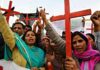
The Christian group Msafara, Swahili for "Safari," spoke after crossing Kenya last month in a caravan of vehicles, dubbed "Wheels of Hope", to visit traumatized survivors and churches which were burned down in the clashes.
Over 300 evangelical and mainstream Christians, including some 120 pastors, participated in the trip to towns that included Mombasa, Naivasha, Nakuru, Eldoret and Kisumu, before returning to capital Nairobi, where the group conducted a prayer service attended by an estimated 5,000 people.
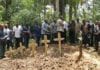
Msafara said that its March 7-17 trip was aimed at supporting reconciliation between warring tribes, especially in Eldoret, where scores of people were burned alive while hiding in the Assembly of God Church.
TRIBAL VIOLENCE
Violence along tribal lines broke out in the town and other areas of Kenya after incumbent President Mwai Kibaki declared victory over presumed favored opposition leader, Raila Odinga, in a presidential ballot on December 27.
Ensuing fighting reportedly left more than 1,000 people dead and scores of churches and hundreds of shops burned or destroyed across Kenya.
A Christian woman who survived the church tragedy in Eldoret said she has "forgiven" her neighbors, who allegedly carried out the atrocity. "I survived because of my faith in Jesus," added the woman, now living in a nearby refugee camp, Msafara reported.
She spoke as church leaders of different tribes in Eldoret tried to overcome distrust among each other during a special worship service, organizers explained.
At the gathering speakers mentioned Bible verse Romans 14:7: "Without righteousness, there can be no peace. Without peace, there can be no true joy. Without these three things, all our work is in vain, as it has nothing to do with God’s purposes."
PASTORS HUG
Later, "pastors began to hug one another in reconciliation," witnesses said. A Kalenjin pastor was seen standing up and begging forgiveness from an opposing tribe.
 He called for a towel and basin and knelt down as he washed the feet of church leaders from that group, witnesses said. "When he was finished, they did the same for others," Msafara said in a statement, seen by BosNewsLife.
A man, whose wife and children "were brutally killed" publicly forgave the murders, added Msafara.
"We were not here to ‘fix’ these towns," stressed Msafara Pastor Muriithi Wanjau, also known as Pastor Muriithi. "We wanted to hold out hope that if the church can work together to care for the hurting and to build and maintain peace, then nothing will be impossible."
It was one of the highlights of the trip, following an emotionally charged meeting in Mombasa, where the convoy met with 200 pastors who, "repented of disunity and pledged to work together in unity," said Pastor Muriithi, who also leads the Mavuno Church in Nairobi.
BISHOP REPENTS
Similar scenes were reported in the heart of Luo tribe territory in Kisumu, the last stop of the ‘Wheels of Hope’ caravan, where befuddled bystanders initially believed they were militants, pastors said.
At a meeting in one the tents set up for music and dancing, Bishop Njiri of the Kenya Assemblies of God, a Kikuyu leader, asked repentance on behalf of Kikuyus who attacked the Luos tribe.
 Fellow Bishop Silas Owiti, a Luo who had taken in Kikuyu refugees, forgave the tribe, and prayed for reconciliation and spiritual healing, Msafara said.
"I saw visibly something I’ve always believed…That the church is the hope of the world. What we experienced in that place was not just the absence of war, but the presence of peace," Pastor Muriithi added.
Yet he cautioned that the caravan of Christians was still confronted with violence, which apparently continued despite a recent peace agreement brokered by former United Nations Secretary General Kofi Annan.
SEEKING REVENGE
As an example Pastor Ken of Kileleshwa Covenant Community Church, who only uses one name, recalled a young man in one of the refugee camps of the ethnically divided town of Nakuru. His wife had been killed just the night before the caravan arrived there, he said. The young man gathered about 100 supporters to carry out revenge attacks, but eventually called-off the violence and became a Christian, Pastor Ken explained.
"I asked him what do you think will happen after your revenge attack?," the pastor recalled. "He answered: "They would come back and seek to take revenge against us." So I told him: "Someone has to break the cycle of revenge…Why can’t it be you?"
The next morning, Ken said, he and two other pastors visited the young man and learned that the attacks had been postponed.
"They had even managed to get a truck and wanted to know where they could get extra weapons. However in the end, the man turned his life over to Christ and agreed to dismantle his revenge mission."
HUMANITARIAN AID
The refugee camp was one of several places visited by pastors in Nakuru, despite concerns churches in the area were too divided ethnically and politically to even meet together.
"They finally relented and allowed Msafara to unload 24 tons of food and supplies at refugee camps, and put on a musical concert. Msafara also conducted a communion service with the pastors," Pastor Muriithi wrote.
"As we shared Holy Communion with each other, a sense of love, unity and openness filled the room, with leaders walking across the room to hug those from other tribes."
Several Kenyan churches and companies contributed to the Msafara’s ‘Wheels of Hope’ caravan. Senior Pastor Oscar Muriu of the Nairobi Chapel Church, said Msafara was able to distribute around 77 tons of food and 25 tons of clothing and hygiene packets. "But the healing of people’s hearts and the reconciliation between ethnic groups amazed us the most," he stressed.
{BosNewsLife Senior Mission Correspoindent (Dr.) John M. Lindner is a writer on mission developments with over 25 years experience. He also heads World Christian Ministries (www.worldchristianministries.org), an organization dedicated to, and reporting on, the tribulation and triumphs of missionaries of the two-thirds world. He received a Doctor of Mission degree by Emmanuel Theological Seminary in Kota, India, in 2005. Dr. Lindner has authored two books: ‘God’s Special Agents’, depicting biographies of 12 mission leaders from the two-thirds world, and ‘The Mountains Shall Sing’, the story of P.M. Thomas and the Himalaya Evangelical Mission.)