killing at least eight people and injuring dozens of others.
Saturday’s explosion in the Sulawesian city of Palu sent nails and ball bearings tearing into vendors and shoppers at the market, which was packed with people buying pork for New Year’s celebrations, police and eyewitnesses said.
Besides those killed, at least 45 people were wounded in the blast, raising fears of more attacks against Christians in the world’s most populous Muslim nation, officials added.
Reporters saw how police and passers-by carried bloodied bodies to cars. One man, apparently unhurt, held his head in his hands as he screamed.
"There was a billow of smoke and then a massive bang, and my ears were deafened," Kartini, a 32-year-old Christian woman who was hospitalized with shrapnel wounds to her chest and feet, told The Associated Press (AP) news agency. "I was in shock and had to tell myself to move away. I screamed for help," said Kartini, who like many Indonesians uses one name.
TWO DETAINED
Police spokesman Rais Adam told reporters that officers were questioning two people detained near the scene of the blast in Palu on Sulawesi island, but stressed the pair had not been formally charged with any crime.
In published remarks, Indonesian President Susilo Bambang Yudhoyono condemned the blast, which occurred despite more than 47,000 soldiers and police being deployed nationwide to ward off attacks.
Saturday’s bombing followed warnings from Indonesia’s intelligence agency that information indicated Islamic extremists may be planning attacks over the Christmas-New Year period against Western and Christian targets in the country, BosNewsLife reported earlier.
The country’s security minister, Widodo Adisucipto, told reporters the bombing was likely linked to terrorist groups. He refused to elaborate, but Jemaah Islamiyah, an al-Qaida-linked group has been among those blamed for a series of bombings in Indonesia, including two attacks on Bali that together killed 222 people, many of them foreigners. It is also accused in Christmas Eve church bombings five years ago that left 19 dead.
RELIGIOUS SPLIT
Sulawesi’s 12.5 million people are mainly split between Christians and Muslims, but there are tiny Buddhist and Hindu communities, AP estimated.
The latest bombings raised fears of more violence against Christians in Central Sulawesi, where fierce battles between Muslims and Christians in 2001 and 2002 reportedly killed at least 1,000 people and attracted Islamic militants from all over Indonesia responding to calls for a holy war.
Several incidents already preceded the blast in November when masked gunmen shot and wounded a Christian couple in the Indonesian province of Central Sulawesi, police and hospital sources confirmed.
45-year old Pudji Laksono, a lecturer at the state Tadulako University, and his wife Novlin Pallinggi, 37, were shot November 19, while on their way home a church service in the provincial capital Palu, said the city’s Police Chief Guntur Widodo.
GIRLS KILLED
That shooting came a day after unidentified assailants reportedly shot three teenage girls in Palu, killing one of them. Catholic news agency AsiaNews reported that another 22-year old girl, identified only as Yanti, died after being wounded Friday, November 18, in the neck by a machete.
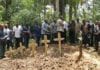
The violence intensified since the October 29 beheadings of three Christian schoolgirls and the shooting on November 8 of two girls in Poso, about 150 kilometers (about 94 miles) from the provincial capital. In addition hundreds of churches, including dozens of churches this summer, have been forced to close down in Indonesia by Muslim militants and local authorities, several human rights investigators have said.
There is also concern about limitations on Christian education as three Indonesian Sunday school teachers, Dr. Rebekka Zakaria, Eti Pangesti and Ratna Bangun, serve a three year prison since September in the Indramayu district of West Java province for allegedly forcing Muslim children to lost an appeal last month.
MODERATE MUSLIMS
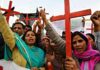
Some moderate Muslim groups have condemned the violence. Members of Banser, a group of youths who wear military-style uniforms and are affiliated with the organization Nahdlatu Ulama (NU) said last month that supporters will be posted to churches nationwide to guard against extremist attacks."
"It is our tradition. It is our obligation to protect one another as members of the nation," said NU Deputy Chair Madar Masudi in a statement.
Christians comprise roughly 8 percent of Indonesia’s over 241-million mainly Muslim people. (With reporting by BosNewsLife Chief International Correspondent Stefan J. Bos at BosNewsLife News Center and BosNewsLife Southeast Asia Reporter Santosh Digal in Manila).